
For thirty years, every shop floor with serious ambitions has been building toward the same dream: a complete digital model of the factory, accurate enough that you could ask it any question and get an honest answer. The CAD model knew the geometry. The ERP knew the orders. The MES knew the work in progress. The SCADA system knew the sensors. Stitch them together and you had a digital twin, a parallel software-only version of the plant that you could query, simulate against, and report from.
This was a real achievement, and it had a quiet ceiling. The digital twin watched. It mirrored. When something broke, it told you. When you asked a question, it answered. But the decisions still happened in human heads, in spreadsheets, in 7 a.m. production meetings. The twin was a system of record, exquisitely up to date and fundamentally passive.
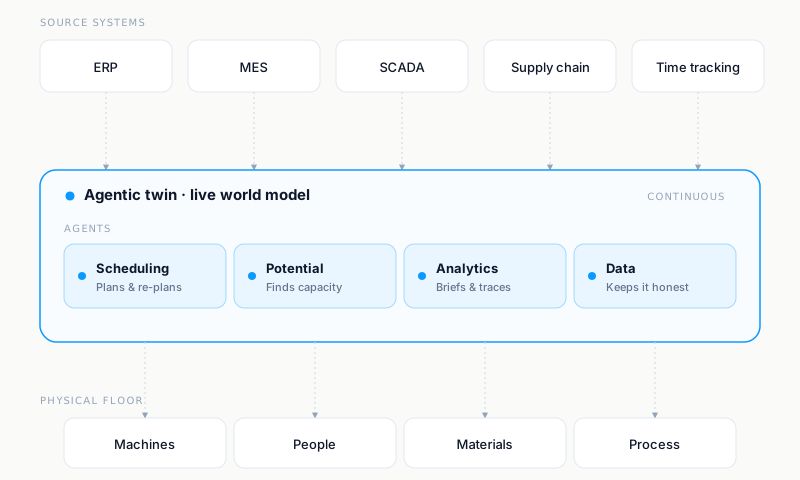
An agentic twin is the next step. It uses the same world model, a live representation of every machine, person, material, and process, and it adds the part the digital twin always left to people. Specialized agents read the state, decide what to do, and act on it.
The twin does not just register that a machine has gone down. It knows which orders are at risk, which qualified operators are available, which alternative routing is viable, and which customer commitment matters most. It proposes the reschedule, explains the trade-offs, and where it has authority, it executes.
Three Properties That Make a Twin Agentic
The first is liveness. An agentic twin runs on current state, not on last night's master data. It absorbs the ERP, MES, SCADA, time-tracking, ticketing, and supply-chain feeds continuously and reconciles them into one coherent picture. When a sensor stops, the planner sees it within seconds rather than on the next morning's report.
The second is reasoning. The twin does not run as a fixed optimizer with a hand-tuned objective function. It contains agents, specialized models that read context, evaluate alternatives, and make defensible decisions even when the situation has never occurred in exactly that form. Every decision is auditable, with a chain of reasoning attached.
The third is autonomy under boundaries. Agents act within a defined envelope. They can re-sequence within today's shift and reassign within a qualified skill group on their own authority, while committing a new customer date escalates to a human. Designing that envelope is the hard part.
How an Agentic Twin Differs from Chatbots, RPA, and Optimizers
A chatbot wraps a language model around a knowledge base. It answers questions well and cannot touch production state. An RPA bot scripts deterministic clicks against fixed forms, doing exactly what it was told and breaking the moment the form changes. A classical optimizer, whether APS or MILP, finds the mathematically optimal plan for the inputs you give it, and the inputs are never quite right, so the moment reality diverges the plan goes stale.
An agentic twin is none of these on its own. It is a live world model with reasoning agents bound to it. It answers questions like a chatbot, automates workflows like RPA, and finds good plans like an optimizer. The difference is that it does all of this against a coherent representation of the actual factory, in real time, and the agents keep that model honest as the world changes.
From Systems of Record to Systems of Action
The ERP, the MES, and the digital twin were systems of record. They told you what was true. An agentic twin is a system of action. It tells you what to do, it tells you why, and once you trust it, it acts. The consequence is operational as much as technical. The cadence of decisions moves from once a shift, to once an hour, to continuously. The shop floor stops being something that gets planned in the morning and fought for the rest of the day, and starts re-planning itself while people focus on the decisions the machine cannot make.
This is the shift that matters. An agentic twin goes well beyond a digital twin with a chatbot bolted on. It is the point where your factory stops being mirrored by software and starts being run by it, with you, your planners, and your operators in the loop where it counts.
Zentio is a live agentic twin for high-mix manufacturing, with specialized agents for scheduling, capacity, analytics, and master-data hygiene. It exists to move the plant's decisions from the morning meeting to machine speed. We built it as a system of action because the plants that win the next decade will be the ones whose decisions keep pace with their floor.