

The conversation about European manufacturing has, in the last few years, taken on a certain fatalism. Energy costs are higher than in the US. Capital is more expensive than in the US. Labor is more expensive than in Asia. The big cost lines are all moving in the wrong direction. The reflexive conclusion is that European industry is structurally outmatched and the only honest question is how slow the decline will be.
The conclusion is wrong, or at least incomplete. The cost picture is real, and it has been used to draw a strategic conclusion the underlying data does not support. To see the actual position, you have to look at what kind of manufacturing Europe still leads in, and what the next decade is going to demand from that kind.
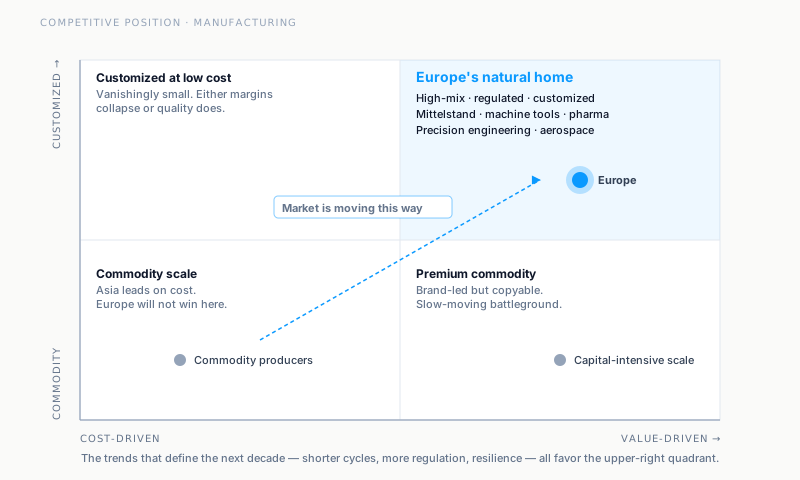
What Europe Actually Does Well
The dominant European manufacturing base is not commodity volume, and it has not been for a generation. The companies that still matter are in:
- Precision engineering: machine tools, drives, optics, sensors, automotive systems, aerospace structures.
- Regulated industries: pharma, medical devices, food, and defense, where certification, traceability, and a tight relationship with the regulator are existential.
- High-mix, customer-specific production: injection moulding, sheet metal, cabling, and contract manufacturing for industries that change their specs every quarter.
- Deep supplier ecosystems: the Mittelstand, the Italian industrial districts, the Swiss precision belt, and the Dutch semiconductor cluster, networks of specialized suppliers that took decades to form and cannot be replicated by capital alone.
None of these are commodity. All of them depend on accumulated technical knowledge, regulatory trust, and supplier relationships that are extremely hard to copy.
What the Next Decade Is Going to Demand
The world is moving toward shorter product cycles, more customization, more regulation, and more supply-chain resilience. None of those trends favor commodity scale producers. All of them favor exactly the kind of manufacturing Europe still does best.
Shorter cycles mean smaller batches and more changeovers, so high-mix becomes the norm rather than the exception. Customization means routings and BOMs change at customer pace, not at planning pace. Regulation turns traceability into the price of entry, and producers without it are shut out of premium markets entirely. Resilience means customers will pay for a European supplier they can audit and reach by car, over a cheaper one whose logistics chain is one geopolitical event away from breaking.
The structural trend is moving toward Europe's existing position rather than away from it.
Where Europe Is Actually Losing
Europe's weakness sits above the engineering, in the operational layer that runs it. The German machine tool builder still makes a better machine than its competitors, and the same machine gets scheduled with a 2008 APS and a planner running Excel macros. The Italian moulder still makes a precision part no Asian competitor can match, and the part takes nine business days to quote because the data lives in five disconnected systems.
The gap between Europe's engineering capability and the software running its operations has become its real competitive vulnerability. The Chinese competitor matches neither the precision nor the depth of engineering, and it still quotes faster, reschedules faster, and recovers from disruption faster, because its operational stack is newer and its tolerance for chaos was forged in a different growth environment.
This is the gap that can close in a decade rather than a generation. The engineering is already there. The supplier networks are already there. What is missing is the software layer that lets a hundred-year-old Mittelstand plant respond at the cadence of a 2026 customer.
What Winning Actually Looks Like
The European position, taken seriously, is to become the world's best at complex, customized, regulated, high-mix production and to operate it at modern software speed. That is a defensible, durable position, and it follows directly from strengths that already exist rather than from optimism about new ones.
The implication for industrial leaders is operational. Stop benchmarking against commodity producers, and start measuring whether your operational stack matches the engineering it sits on. A plant that can build the part but cannot reschedule when an order changes loses time on every order, and lost time is a cost. Latency is the one line in the cost stack that software can collapse inside a fiscal year.
This is the position Zentio was built around. We are a European company, building production intelligence for a European industrial base whose physical capability does not yet have software to match. The bet is straightforward: the next decade of European competitiveness will be decided by which plants modernize their decision-making, and that is the layer we are working on.