
There is a particular kind of meeting that happens in every plant of a certain size, and once you have seen it, you cannot unsee it. The production manager raises a problem. Five people offer opinions. Then, after a beat, everyone turns to one person, usually older, usually quiet, usually holding a coffee cup with their first name on it, and asks: 'Klaus, what do you think?'
Klaus thinks. Klaus says: 'Run that on machine 7 with the second-shift crew, but do not start until the changeover from the medical order finishes; the heat shift will throw off the tolerance for the first three parts. Push the BMW order to Thursday; their logistics does not pick up until Friday morning anyway. And give the lathe job to Tomasz, not Karol, because Karol is still learning the new fixture.'
Everyone nods. The meeting moves on. Nothing about Klaus's reasoning is in any system in the building.
The Structural Problem
This pattern is not anecdotal. Across European manufacturing, the planners and shift leads who make these calls every day belong overwhelmingly to one demographic cohort, and that cohort is retiring. Conservative estimates put the share of skilled production planning and shift-management labor that will exit the workforce in the next decade at between a quarter and a third.
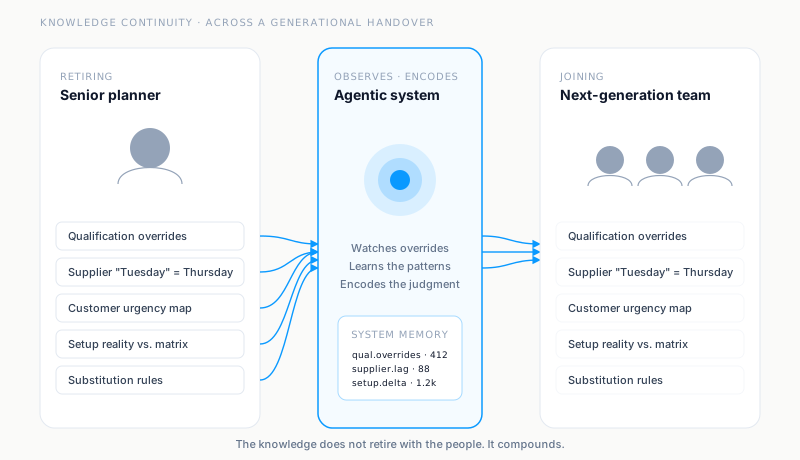
The accumulated knowledge they leave with is, in a real and underappreciated sense, the operating system of the plant. It is the knowledge of:
- Which machine is officially qualified for a part versus which one actually runs it best.
- Which operator can substitute for which, even when the qualification matrix says they cannot.
- Which customer can absorb a one-day slip without escalation and which one cannot.
- Which supplier's 'Tuesday' really means Thursday.
- Which order can be split, which cannot, and why, where the why is a story from 2014 that nobody wrote down.
This is judgment rather than information, built up over careers rather than training programs.
Why Training the Next Generation Does Not Solve It
The first instinct, reasonable on its face, is to hire and train replacements. Pair the next generation with the retiring one for a year or two and transfer the knowledge.
In practice this does not work, for three reasons.
The first is that the knowledge is tacit. The senior planner picked it up over twenty-five years of failures, and no manual or curriculum compresses that.
The second is that the labor market does not cooperate. The next-generation hires that the industry needs are not arriving in the numbers it needs them. The skilled trades have lost prestige in most of Europe over the same decades that the senior cohort was accumulating its expertise. The replacement ratio is structurally below one.
The third is that the world the senior planners learned in is gone. They are masters of a regime of long runs, stable specs, and predictable supply that no longer exists. Even a perfect knowledge transfer would be teaching someone the wrong game.
What Intelligent Systems Actually Do Here
The honest framing is about encoding the senior planner's judgment as system behavior, so the next generation does not have to relearn it from scratch. Replacing the planner is the wrong goal.
An intelligent system that runs continuously against the actual production state learns what Klaus knows, in a different form and over time. Interviews lose ninety percent of what he knows, so the system learns instead by observing the decisions he makes, the overrides he applies, and the patterns in the data that track his interventions. The qualification matrix gets richer as the system notices which substitutions work. The setup matrix gets richer as it notices what really took 32 minutes against a booked 45. The customer urgency model gets richer as it notices which orders moved without consequence and which triggered a call.
What the plant ends up with is a system that, when the next generation of planners walks in, hands them a starting position that took Klaus twenty-five years to build. It is not a digital Klaus, and it does not need to be. The senior planner's contribution stays in the building after they leave, and it keeps compounding.
This also changes what the next-generation planner has to be. Memorizing a thousand operator-machine-part interactions stops being the job. The job becomes judging the recommendations the system makes, serving as the escalation point for the cases it cannot handle, and being the human face of the plant to customers and operators. Those are skills the labor market actually produces.
What Is at Stake
The plants that lose Klaus and do not have a system to absorb his knowledge will be visibly worse-run within three years. The plants that capture and operationalize that knowledge will be the ones still running well in a decade. The window is the next five to seven years; after that, the cohort is gone and so is the option.
This is a story about a generation of irreplaceable workers leaving, and about what manufacturing has to do so its competitive position does not walk out with them. The headline about AI replacing workers misses it entirely.
This is part of why Zentio exists. The agents plan every shift and learn from it, capturing the judgment that has historically lived only in senior planners' heads and making it available to the team that has to run the plant tomorrow. We built them this way so the knowledge does not retire when the people do.