

Walk into the production office of a high-mix plant at 6:45 a.m. and you will find the same scene in any country, any sector. Someone has the morning plan up on a screen. The shift lead is going through the orders. There is a printout. There is a Gantt chart. There is, somewhere, the spreadsheet that was the actual source of truth before it was retyped into the system.
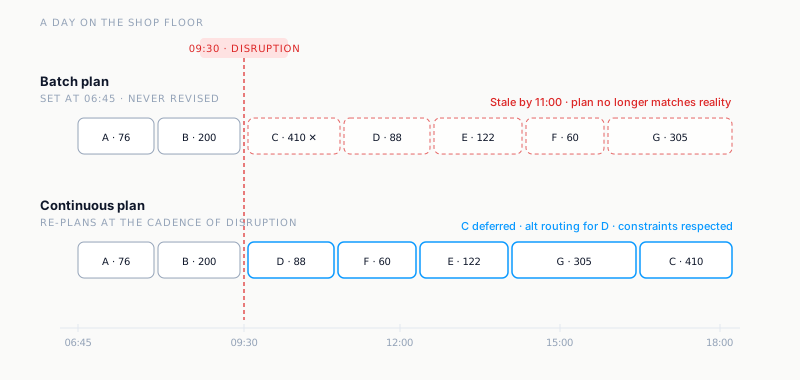
By 9:30, that plan is wrong. A machine has stopped. An operator called in sick. A material came in late. A customer pushed an order forward. The planner pulls open the spreadsheet, rearranges it, walks the new version to the line. By 11:00, it is wrong again. And so on.
None of this reflects bad planning. It is the structural condition of high-mix manufacturing in the 2020s, running on planning systems built for a different era.
Where the Old Architecture Came From
Classical APS and MRP systems were designed in a world where the plan was the unit of work. You ran the optimizer overnight, you printed the schedule in the morning, and the schedule was the contract for the day. Variance was expected to be small. The math problem was straightforward: given stable inputs, find the optimal sequence.
That world had three properties that quietly underpinned everything:
- Long runs. Setup costs dominated, so batches were large, and a small disruption did not require a fundamental re-plan.
- Stable specifications. The order you saw in the system was the order that ran.
- Predictable labor. Crews were stable, and qualifications mapped cleanly to roles.
In a low-mix, high-volume world, those assumptions held. The plan was a plan because reality cooperated.
Where the World Actually Is Now
The reality of a high-mix plant in 2026 looks nothing like that.
Batch sizes are smaller. A typical injection moulder or precision shop runs orders of dozens, not thousands. Setup time as a fraction of run time has gone from 5% to 30% and is still rising, which means a single mis-sequenced order can lose half a shift.
Specifications change late. Customers iterate on drawings. Quality holds parts back. Engineering revises a tolerance the morning the order is supposed to run.
Supply is volatile. Material delivery dates that used to be reliable to the day are now reliable to the week, on a good week.
Labor is the new bottleneck. Skilled operators are scarcer, qualifications are narrower, and absences cluster. The qualification matrix has become as complex as the routing matrix.
In this world, the plan is a hypothesis with a half-life measured in hours. Treating it as a contract for the day is the mistake.
Why Batch Re-planning Fails
The instinctive response, when the morning plan goes wrong, is to re-run the planner. Tonight's batch will be better than today's was.
But the disruption did not happen overnight. It happened at 9:30. The cost of running with a stale plan from 9:30 to the next morning's batch is enormous: a sequence of wrong setups, a string of operators waiting on parts that will not come, missed customer commitments, and a shift lead spending the day firefighting instead of leading. By the time the new batch runs, the variance has compounded into the next day's plan.
Worse, the manual re-planning that fills the gap is brittle. The planner cannot hold the entire constraint set in their head, so they fix the immediate problem and create three downstream ones they will not see until tomorrow. The math defeats anyone here, with hundreds of orders, dozens of resources, and a constraint graph that does not fit on one screen.
Real-Time as the New Floor
The honest implication is that re-planning has to happen at the same cadence as the disruption. If disruption is hourly, re-planning has to be hourly. If disruption is real-time, re-planning has to be real-time. The plan stops being a document and becomes a process.
Humans do not disappear from this picture. They move from making the plan to steering it. The system handles the fifty micro-reschedules a day that no person could, while the humans handle the five decisions that require judgment, a customer relationship, or a phone call.
The deeper shift is from planning as an event to planning as a flow. Once the cadence is continuous, everything else speeds up, from capacity decisions to customer commitments to root-cause analysis, because the underlying state is finally in sync with reality.
Zentio's scheduling agent does exactly this. It re-plans continuously, weighs every constraint, and explains every change, so the plant's plan finally matches the plant's reality. We built it as an architecture rather than another optimizer, because the morning meeting has been losing the same fight for thirty years and a faster optimizer was never going to end it.